The Story Behind the Recipe
A tray dessert with serious nostalgia
This type of dessert — set gelatin with a cream element poured over or set within — appears in various forms across Mexican, Asian, and Eastern European dessert traditions. What they share is a commitment to texture contrast: the firm, wobbling resistance of the jelly against the smooth pour of cream or condensed milk. It is fundamentally a textural dessert as much as a flavour dessert.
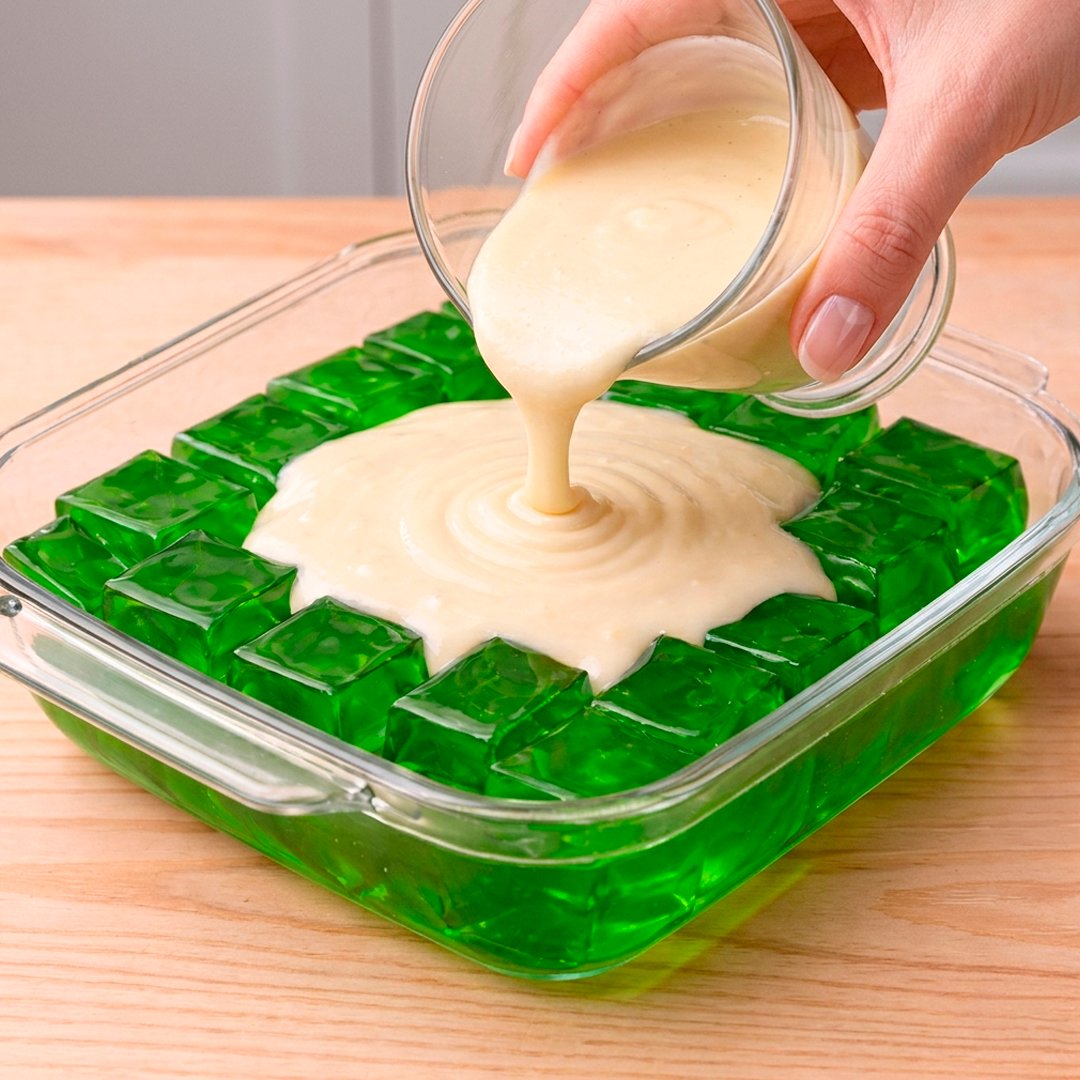
The green colour here is not artificial — it comes from lime or melon flavouring at sufficient concentration to produce that deep, almost jewel-like emerald. The visual drama of the cream being poured over the cubes is half the appeal: the white liquid finds its way between the green blocks and fills in the arrangement from below, creating a contrasting mosaic effect.
The Technique
Four stages, clearly explained
01
Set the green jelly base in a flat tray
Dissolve lime or melon gelatin in hot water at 10–12g per 500ml for firm cubes. Pour into a flat, lightly oiled tray and refrigerate until completely firm — about 3 hours minimum.
02
Cut into uniform cubes and arrange in the serving dish
Cut the set jelly into cubes of approximately 2–3cm. Arrange them standing upright in a glass dish, leaving deliberate gaps between them — the cream needs space to fill.
03
Make the condensed milk cream
Whisk sweetened condensed milk with cold whole milk in a 1:3 ratio until combined and smooth. This should be fluid enough to pour but rich enough to coat each cube as it settles.
04
Pour, chill, and serve
Pour the cream mixture slowly over the cubes, allowing it to find its own level between them. Refrigerate for another hour before serving directly from the dish with a large spoon.
Key Variable
The cream ratio is the critical decision
Too much condensed milk relative to whole milk and the cream is too thick to flow between the cubes — it sits on top in a slab rather than finding its way around each piece. Too little and it is watery and separates. The complete recipe specifies the exact ratio that produces the consistency shown in the photograph — fluid, rich, and opaque white.
One practical note: pour the cream at refrigerator temperature, not room temperature. Cold cream sets more slowly as it contacts the cold jelly, which gives it more time to settle evenly around the cubes. Warm cream begins to slightly dissolve the jelly surface at the contact points, which softens the edges of the cubes and blurs the contrast.